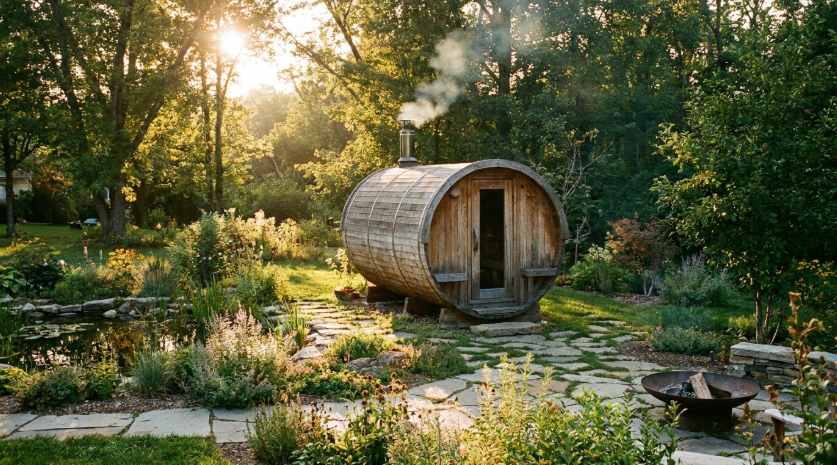
Most electric barrel saunas sized for 6 people need a dedicated 240-volt circuit, because their heaters typically run 6 to 9 kilowatts, well above what a standard 120V household outlet can safely handle. A small side-yard installation does not change that requirement, though it does affect how far the electrician has to run the circuit and what that run ends up costing.
What Voltage Does Your Barrel Sauna Heater Actually Need?
The heater’s nameplate, not the barrel’s size on paper, determines the wiring requirement. Electric heaters below about 4.5 to 5 kilowatts can sometimes operate on a dedicated 120V, 20-amp circuit, but that range covers very few 6-person barrel saunas, which almost universally ship with 6, 7.5, or 9 kilowatt heaters to reach and hold 170 to 190 degrees inside a curved interior with real air volume. Before assuming anything about your specific unit, check the heater’s spec plate or the listing for its kilowatt and voltage rating; that single number decides the rest of this process.
Step 1: Check the Heater’s Kilowatt Rating
Every sauna heater lists a kilowatt figure and a required voltage, usually printed on the unit itself and repeated in the product manual. A 6 kilowatt heater at 240V draws roughly 25 amps; a 9 kilowatt heater draws closer to 38 amps. Write this number down before calling an electrician, since it determines breaker size, wire gauge, and whether the existing panel has room. Buyers still comparing barrel models can browse SweatDecks the SaunaLife E8 to see heater kilowatt and voltage specs listed directly on the product page before committing to a wiring plan.
Step 2: Confirm What Your Panel Can Support
A licensed electrician (or, as a first pass, a look at your panel’s label and any spare breaker slots) tells you whether there is room for a new 30 or 40-amp double-pole breaker. Older 100-amp panels in smaller homes are frequently already close to capacity once central air, an electric range, and other large loads are accounted for, in which case adding a barrel sauna heater may require a panel upgrade rather than just a new breaker. This step is worth doing before falling in love with a specific model, since it can shift the total project budget by a few thousand dollars.
Step 3: Decide Between a New Circuit and a Sub-Panel
For a barrel sauna sitting close to the house, a single dedicated run from the main panel is usually the simplest and cheapest option. For a unit placed farther out in a small yard, near the back fence line or a detached garage, some electricians recommend a small sub-panel to keep wire gauge reasonable over distance and to leave room for a future addition like exterior lighting or a pump. Either approach satisfies code as long as it is sized to the heater’s amp draw with the correct wire gauge for the run length.
Step 4: Budget for the Electrician, Not Just the Sauna
A straightforward outdoor 240V run for a barrel sauna, including a weatherproof disconnect switch within sight of the unit and GFCI protection, commonly costs $800 to $2,500 depending on distance from the panel and local labor rates. A longer trench run, rocky soil, or a panel that needs upgrading first can push that number well past $3,000. Getting a firm electrician’s quote before ordering the sauna itself avoids the common mistake of budgeting only for the unit and being surprised by the wiring bill afterward.
What About Small Barrel Saunas That Run on 120V?
A handful of compact 1 to 2 person barrel or pod-style units ship with heaters under the 4.5 kilowatt threshold and can run on a dedicated 120V, 20-amp circuit, which is a much smaller electrical job. This is not the norm for 6-person barrels, which need the airflow and recovery time that only a larger heater on 240V can reliably deliver, but it is worth knowing if a smaller footprint is genuinely on the table for a tight lot.
Step 5: Check Whether a Permit and Inspection Are Required
Most jurisdictions require an electrical permit for a new 240V circuit, even for a small outdoor project like a barrel sauna, and skipping that step can create problems later, from a failed home inspection at resale to an insurance claim getting denied after storm or fire damage traced back to unpermitted work. A licensed electrician typically pulls the permit as part of the job and schedules the inspection once the work is done, so this step rarely falls on the homeowner directly, but it is worth confirming upfront that the quote includes permit fees rather than finding an extra line item added later. Some smaller municipalities move faster than others on scheduling inspections, so building a week or two of buffer into the installation timeline avoids a barrel sauna sitting wired but unusable while waiting on a final sign-off.
It is also worth asking the electrician whether the barrel sauna’s location, particularly for an outdoor unit near a fence line or property boundary, meets local setback rules for exterior electrical equipment. This is a separate question from the wiring itself, but it is one that surfaces during the same conversation and is easier to resolve before a pad is poured or gravel is spread than after.
Does a Barrel Sauna Heater Need GFCI Protection?
Most local codes require ground-fault protection for outdoor electrical equipment, and many sauna heater manufacturers specify a GFCI or GFPE (ground-fault protection of equipment) breaker as part of the installation instructions regardless of what local code technically requires. This is a slightly different device than the standard GFCI outlet found in a bathroom, and not every electrician defaults to it without being asked, so confirming the heater manufacturer’s own installation manual and handing a copy to the electrician before work starts helps avoid a mismatch between what gets installed and what the heater’s warranty actually requires. Skipping this detail will not necessarily stop the sauna from working, but it can create a warranty problem down the line if the heater ever needs a claim.
Frequently Asked Questions
Do all barrel saunas need a 240V circuit? No. Most heaters above roughly 4.5 to 5 kilowatts need 240V, which covers most 6-person barrel saunas. Smaller units under that threshold can sometimes run on a dedicated 120V, 20-amp circuit.
How many amps does a barrel sauna heater draw? A 6 kilowatt 240V heater draws roughly 25 amps, and a 9 kilowatt heater draws roughly 38 amps, so installations typically use a dedicated 30 or 40-amp breaker.
Can an electrician run a 240V circuit to an outdoor barrel sauna? Yes, this is routine work involving outdoor-rated cable or conduit, a disconnect switch near the unit, and GFCI protection as required by local code.
What does it cost to add a 240V circuit for a barrel sauna? A straightforward outdoor run commonly falls in the $800 to $2,500 range, with longer runs or panel upgrades pushing the cost higher.
References
- Cardiovascular and Other Health Benefits of Sauna Bathing: A Review of the Evidence, Mayo Clinic Proceedings, 2018
- Benefits and risks of sauna bathing, The American Journal of Medicine, 2001
- Does the Combination of Finnish Sauna Bathing and Other Lifestyle Factors Confer Additional Health Benefits? A Review of the Evidence, Mayo Clinic Proceedings, 2023
By Dana Whitfield